Category Archives: Uncategorized

Content marketing: golden boot or own goal?
As an Arsenal fan, watching Arsene Wenger’s charges plot their way to the perfect goal can be a tiresome experience. The mind can easily wander. Perhaps to one of the electronic pitchside ads which are intruding so brazenly on our beautiful game. There’s Europcar inviting us to visit Europcar Sport. Now immediately I’m sceptical. This is content marketing, clearly. This is a sponsor wishing to ‘engage’ ‘meaningfully’ with supporters by providing content of value to them. But what, I ask myself, can a car rental company offer beyond what I get from the official website or countless news websites?
The answer is as predictable as an Arsenal attack at the moment. Nicely packaged, but no real end product. There’s a news feed (arsenal.com gives me that) and a list of player twitter pages. The only unique content is a guide to parking for travelling supporters. Time to get back to the game then.
Brands are falling over themselves to join the content marketing craze. For me, content marketing means a brand informs me or entertains me in return for the exposure – this is the value exchange. Unfortunately too many brands stray into areas where they can’t deliver real value. Either the content is weak, or they simply churn out third party material. Lazy.
A more edifying experience this month came in the form of the annual Carat Media Forecast in Marketing magazine. This was content marketing worth taking time out for. The difference? These people are expert in the field so their content is genuinely useful. While I’m at it, here are a few nuggets from the report:
- This year digital spend will exceed TV for the first time … and that excludes mobile
- The use of ad blocking will bring a sharp rise in native and paid content
- We continue to love radio, and that goes for young people too, even in the face of Spotify, iTunes and other platforms
- Within 5 years all audio visual advertising (TV, VOD, YouTube) will be bought across devices from a single source, and served based on cookie data. Young singles will no longer be watching ads for nappies!
Marketing as a discipline is probably too prone to fads. Like brands going social purely to follow the crowd, when it’s not really what they are. Content marketing is another example. Customers quickly see through it if it’s forced, so only do it if you can do it well. Otherwise, like many a Ramsey-Walcott combination, it can be a whole lot of effort for precious little reward.
A journalist scorned
Safe to say, Henry Gomez has had better weeks. Annoyed at how Financial Times colour writer Lucy Kellaway had ridiculed his CEO’s words of wisdom at Davos last month, the communications chief at Hewlett Packard Enterprise put pen to paper, expressing his dissatisfaction at such treatment of an esteemed business leader. He concluded with a thinly veiled threat that such behaviour might affect future ad spend in the pink pages.
Ms Kellaway didn’t take kindly to this rebuke, and promptly disclosed his letter and her no-nonsense response in Monday’s FT. She wasn’t holding back. The FT’s editorial, she’d have us know, is never swayed by ad bucks, and anyway, Gomez would surely be breaching his duty to HPE’s shareholders by withdrawing spend deemed to be in the best interests of the company for the sake of simply showing a hack who’s boss.
Most PR practitioners have been there. A client is miffed at how their brand has been mistreated by the fifth estate. Sometimes it’s justified, sometimes it’s just them being a bit too precious. Either way there’s a dilemma for the PR professional caught in the middle. Kellaway laments the fact that years ago such dilemmas inevitably led to a cordial lunch with the CEO, whereas nowadays they are mostly met with silence.
In my experience, the crisis is typically an opportunity in disguise. Often the journalist will have gone a bit too far, without factually misrepresenting the client brand. In the Kellaway case, her jab at the HPE boss was a bit mean, a bit petty, but was mitigated by her customary tongue-in-cheek style that won’t have influenced the reader’s view of the brand one iota.
Hold fire. The client will want a retraction. The journalist won’t. Far better to suggest a right to reply, or, if the perceived misdemeanour is less clear-cut, a separate piece of editorial in the future that benefits the client without requiring a comedown from the journalist. Chances are the reader won’t have been nearly as sensitive to the offence in the first place, and a positive article will be a considerable net gain for the client. Or maybe make your point, and just be nice about it. In the midst of adversity, your understanding might even win you an ally in the media, as opposed to an enemy, as is clearly the case here.
Given the job he’s in, I’m sure Mr Gomez has lots of ink at his disposal. Next time, he might be more careful about how he uses it. Sorry, couldn’t resist it.
An industry that just can’t say no
(Watch first, then read on …)
It’s not comparing like with like, but there’s an underlying sentiment in this engaging piece that will resonate with most people in the creative industries. The same sentiment that steers lots of us clear of the dreaded tender process which demands creativity be handed over upfront, for free, with no solid prospect of getting any work in return. Quite often, the tender process IS the work. It’s not just clients who are to blame, it’s an industry that has allowed these rules of engagement become the norm.
Granted, some of the analogies are a stretch. Can a client be expected to pay for a campaign but forego the IP rights to it at the same time? Not if he or she wants to prevent it being used by a competitor the following week. Do I always fork out in advance for my breakfast or picture frame, with no recourse if I’m unhappy? No, I don’t. Still, there’s a message here which all of us need to be more mindful of when seeking out the next buck.
Brushing big shoulders at Websummit
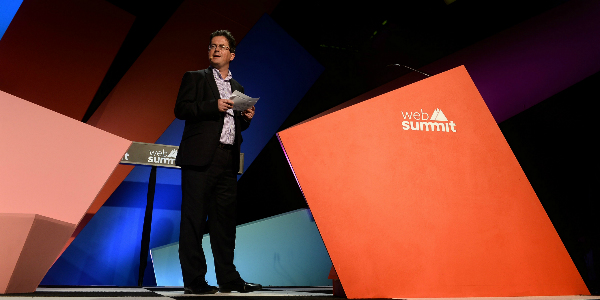
If you were ever asked to be Master of Ceremonies at a business conference, the following might count as a dream line-up: Amazon, Forbes, CBS, Wall Street Journal, Andressen Horowitz, Washington Post, The Onion and the BBC. So it was great to be invited to MC the final marketing session at this year’s Websummit in Dublin, and brush shoulders with the good and great of our trade, among them John Sculley, ex-CEO of Apple.
It was my first time at the Websummit and I was duly impressed with the organisation. 40 speakers to navigate at the marketing summit and not a minute’s overrun. Especially noticeable was what you might call light-touch management: the event management team at the marketing summit knew their stuff and were let get on with it, with no sign of any meddling senior bosses getting in their way. That’s probably the modus operandi of the Websummit team generally – and another feather in the cap of founder Paddy Cosgrave.
Advertising as entertainment … roll up, roll up
We’re forever hearing that the future of TV advertising is as entertainment. Personal video recorders means no one is watching ads, and the only hope of countering this ‘ad avoidance’ is by making your ad as good as the programmes that it punctuates.
That’s all very well, but what about the ads around yours? Just who is going to sit through mind-numbingly dull dross to happen upon your 30 second gem?
(You won’t hear it in adland, but it is suggested that a far simpler response to ad avoidance is to stick a big fat logo in the heart of your ad so even the most ad averse types can’t avoid it as they zoom through at 30x)
Anyway, the thought struck me as I watched the UK Lotto’s ad with Piers Morgan. This really is tongue in cheek entertainment on a par with anything you’d sit down and watch deliberately. So sit down and enjoy!