Category Archives: Uncategorized

Creativity – all in the delivery?
For those in adland who bemoan the supremacy that technology is enjoying over creativity, John Gapper’s article in the FT on the Cannes Lions festival (“Advertising’s creative vision is old fashioned”) ) will be a less than edifying read. In fact, the world’s premier knees-up for advertising creativity reads more like a tech fest. Where once the applause was reserved for lavish artistic work, now the garland goes to the most innovative means of delivering it.
As Gapper reports, “Most advertisers simply want to find people as efficiently as possible and persuade them to buy things, whatever the format. That leaves the copywriters and video auteurs in agencies feeling unloved.”
A telling example is given of KFC struggling to sell its fried chicken in China. Whereas before the default solution might lie in a stand-out creative, in this case the brand relied on a loyalty scheme tied to a mobile phone ‘super app’ allowing you to pre-order food, select music in the outlet, and a play a version of fantasy mobile game with their friends. Nor was this the brainchild of a conventional ad agency, but a ‘digital transformation’ provider.
Gapper makes the point that broad brush brand advertising is being replaced by engagement with people who already like the product – as delivered by online algorithms in mobile display advertising.
“Anything on which the return cannot be measured is vulnerable.” Concerns are expressed that the ad industry may become ‘juniorised’ with big thinkers being substituted by cheap copywriters because there is “not enough in the kitty for the magical.”
There are learnings on both sides. Agencies need to accept that brands are no longer modern-day patrons of their art. They won’t stand for the prima donna practices of old. For their part, brands need to realise that reaching the audience is one thing, but it is rarely a long term differentiator in itself. Ultimately it is the art of persuasion that seals the deal, and this only happens with creative magic that resonates in a unique way with your audience. And that’s art, not science.
Horgan PR Classic

Poor event planning to win your own golf tournament I guess, but no one complained at the Grange Goolf Club recently.
Thanks to Hilary Hall, AMBCS of Research and Markets for the bubbly and Colm Handley for arranging the day. Well done to runners up Des Burke of SQ9 and Eoin O’Herlihy B Tech (Ed.), M.Eng, CEng MIEI and to all the companies at the Guinness Enterprise Centre who took part.
http://gec.ie/augusts-horgan-pr-golf-classic/
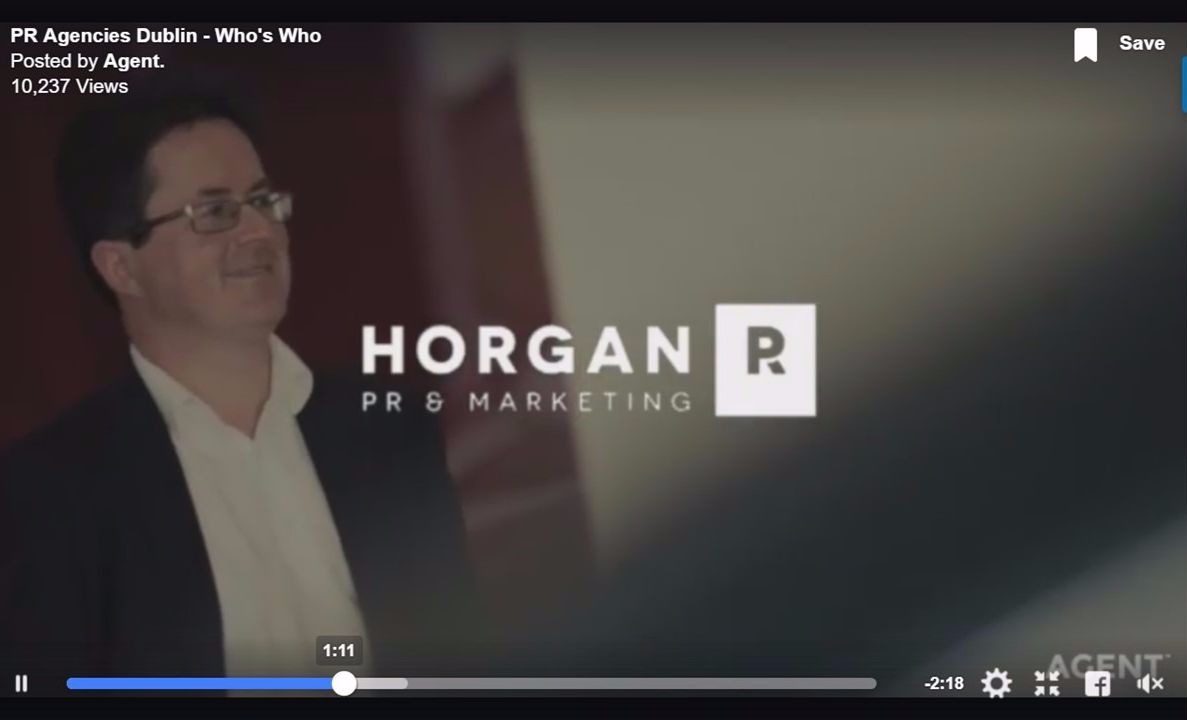
Who’s who guide to PR in Dublin
https://www.youtube.com/watch?v=dZLiuQgWFYU
Nice to be granted a place among such well established firms in the AGENT “25 most successful agencies in Dublin”. As in every industry, each player has its strengths. We like to think ours is experience of the entire marketing spectrum and an eye for the commercially viable, with a large dose of common sense thrown in!
See the entire article here: http://www.agent.media/lead/pr-agencies-dublin/

Can’t you get your staff to like you?
I’ll be criticised for placing undue weight on likes as opposed to reach when it comes to social media posts. After all, you can read a newspaper without feeling the need to applaud every article. But, admit it, we can’t help seeing likes as a proxy for the success of our work online.
It’s forever fascinating, then, that brands struggle to amass even a handful of likes for their posts. Can’t they get at least their staff to like them? More pertinently, don’t their staffs feel the need to support them? After all, that’s what likes typically are – a show of support for the author rather than an endorsement of quality content.
I know there are reasons why a staff member might not like every post, as their friends will soon tire of being exposed to every post liked by them. But I’m not buying that as the explanation as to why so many companies fail to secure a single like from their workforce. It has to be something else. Maybe it’s the staff member saying, “Hey, this is my private space, back off!” Or maybe it’s just a subtle outlet for them to express that they don’t really like where they work, or who they’re working for.
That’s likely to be how a prospective client or employee reads it. And there’s real issue with lack of likes. It reflects badly on your brand. So encourage your staff to like your posts. Or, better still, just be more likeable!

Branded content: A tough trade for the TV execs
My MBA thesis was about product placement. It was all of 10 years ago, when the term was unfamiliar to most. One of my conclusions, I recall, was that the scarcity of suitable home-produced programming would curb its emergence as a force in Ireland.
Recently I watched The Toughest Trade, the first, or most high-profile, example of “branded content” to hit our screens. So here’s the distinction. Product placement is about paying to include your brand in an existing programme. Branded content has the same aim, but here you produce and pay for the entire programme yourself. The brand is taking control.
On paper it looks a terrible idea. On screen it looked good. The subject matter was ideal – the boy-next-door heroes of the GAA mixing it with the monied stars of world sport, and AIB to thank for giving them and the sport an outing the like of which they’d never dream of.
Brand intrusion? Beyond a few conspicuous hoardings at Breaffy Park, there was a surprising absence of photo-bombing by out-of-focus AIB logos. Ultimately, the broadcaster still decides whether it’s a legitimate programme, as opposed to a commercial. The credits reveal that RTE and TV3 had executive producers on hand just to keep anyone from veering offside.
So why didn’t RTE just make it? Life’s not like that anymore, and increasingly it will be courageous (and deep-pocketed) brands as opposed to wary (and cash-strapped) producers who we’ll be relying on for this type of innovative content. And that does mean handing over control, from broadcaster to brand, to some extent anyway. It’s a tough trade, but this was a fair start.