Category Archives: Uncategorized
Inbox fatigue … it’s not only customers who are suffering
We’re tired of hearing about information overload in today’s society, and about the unsurmountable struggle with the Inbox. A recent article from Advertising Age* is a variation on the theme, with consumers the sufferers in this case.
Less email is more, we’re told. Consumers are ever more prone to ignore emails, given the daily drudge of sorting personal from promotional, real invitations from commercial ones, and so on. The rise of social media, too, is furthering the decline of email as a marketing tool. “RIP, traditional email.”
The problem, of course, lies in how companies use emails. They use too many of them. Ad Age recommends getting more selective and more personal with what we send out, beyond simply including a perfunctory “Dear Conor”, which fools no one. Data–driven marketing enables us to have more meaningful targeted ‘conversations’ with customers, but, let’s face it, when have we ever really had one? Amazon comes closest, in my opinion.
I was at an insightful marketing talk with a supermarket chief last year. Someone from the audience asked why – given the amount of information the multiples collect on everything she buys and how she buys it – she doesn’t receive a weekly email the day before she goes shopping advising her of relevant bargains she can avail of. Sounds simple, and its absence typifies the way we seem to be almost lazy in what we’re doing via email. As the article states, “The advantage is there to be seized. All companies have to do is send the right message to the right person.”
On a separate but related note, I often think email is the scourge of the PR profession, but in a different way. With media lists reaching into the hundreds for just about whatever sector you’re targeting, it’s easy for the new PR recruit to think a press release pinged to a hundred hacks is bound to stick. After all, if 10% run with it, that’s 30 articles. Happy days.
That’s not a good start to a career in PR, believe me. The journalist is suffering more from email overload than any consumer, and it will show in the uptake of releases sent by email. Plus, where’s the relationship-building that’s at heart of the business? If the service is just about managing a media list, don’t expect clients pay for it for too long.
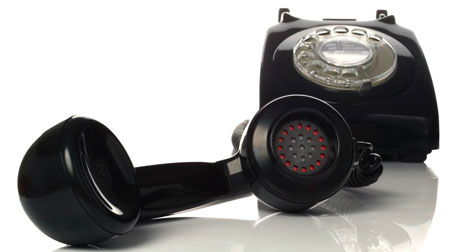
I recall asking a journalist what was the key to securing press coverage. “A phone call” was his three-word answer. Much as we might hate having to make them, much as we might fear the rejection that comes with them – and much as journalists are annoyed by them – a single phone call is still worth many hundred emails. We’re a people business, and being personable means picking up the phone. In a world where text dominates, where remote social contact among young people is rarely down a phone line, this is one thing we need to instil into our PR recruits.
In PR especially, it really is good to talk.

Now Google wants high-quality, in-depth, newsworthy content. No change then.
We fear that which we don’t understand, and that gives us good reason to fear Google. None of us grasps how this algorithmic behemoth works and this is the very basis for its dominance. Talk this week has been of Google’s previous aversion to press release material being reversed, or at least halted.
The tale goes something like this. The comms world is all about search. In the past, landing your story in a mass circulation title – typically the holy grail of the PR – would help the story on search. Google stopped all that, its Panda 4.0 algorithm identifying pick-up of press releases and devaluing this content. Now a new algorithm means press release and search can feed off each other again, but only if it uses its own channels, and only if the content is – get this – high-quality, in-depth and newsworthy.
So if you’ve been netting coverage in high circulation media with material that is low-quality, shallow and unnewsworthy, – which I can’t imagine – you’re in trouble. If, like most of us, you haven’t, this new world shouldn’t fill you with terror. Rest easy: what’s happening here is that Google is clamping down on brands spamming us with endless mindless dross masquerading as news. That apart, as ever with Google, we’re really none the wiser.
PS Whatever others will have you believe, communications is NOT all about search. By definition, search is what the market actively asks for: media relations is mostly about disseminating messages that are relevant and interesting, but haven’t been requested. That’s why they’re called news.
A Masters in Economics
Can we really get too much of a good thing? Well, I do recall the economics I learned all those years ago being founded on scarcity: increase demand and curb supply to raise value. I remember thinking this is something the Masters Committee does really well. Limiting TV coverage to just three hours a day left us all wanting much, much more of Seve and our other heroes in the fairytale setting that is Augusta. The British Open was great, but with the cameras rolling from 9am each day, a kid’s interest did flag at a certain point. Everything about the Masters was understated, and this was its brand appeal.
It still is, but it’s changing. Sky is great for sport, they say, and mostly it is. But football is surely passing saturation point, rugby is getting there, and the Masters itself is not safe. Three hours of the par 3 competition, daily breakfast shows, wall-to-wall re-runs of past tournaments … it all adds up to more than a hint of viewer fatigue by the end of the week.
The Masters enjoys an enviable aura, and like the Hollywood stars of old, that’s due in part to its inaccessibility. Let’s retain some of that.
Meanwhile, enjoy the undisputed Ad of the Month from Nike. Predictable, yes, but irresistible all the same!

From whodunnit to yes we know who’s doing it
The TV talk of the year so far has been Red Rock. The first episode impressed, but I admit I haven’t been back since. My reason for looking was in expectation of the series ushering in a new era of product placement … after all, this is a very expensive outing for TV3. Much of the talk after was of whether it’s a soap or a thriller – it’s a bit of both – but for me it was more a whodunnit, because I just couldn’t work out who was behind the product placement. The credits at the end gave the game away: the Irish Daily Mail and Costcutters had obviously (or not so obviously) forked out to have their wares on screen. Not too much, I hope, because despite my attentions they both slipped by me unnoticed. Surprising, but comforting to know artistic integrity was upheld.
All was corrected in the very next programme, The Restaurant, a migrant to TV3 after many seasons on the State channel. Here there was no doubting who had dunnit. One reviewer spoke of the Aldification of the programme and indeed there was no missing the discounter amid the ingredient shots, the branded wine cases and the very overt captioning of the meat producers as ‘Aldi Supplier’. As against that, it does make sense in the editorial context of the show, and in theory the Aldi produce is as much open to criticism from Mssrs Doorley and Co. as the cuisine itself.
It all takes getting used to, but get used to it we will. TV advertising is under threat thanks to personal video recorders, and product placement will have to step into the breach. I can’t see any meaningful revenues in subtle product placement à la Red Rock. It won’t be to everyone’s taste, but it’s far more likely to be served up to us like in The Restaurant.
Litter: time to start humming a different tune
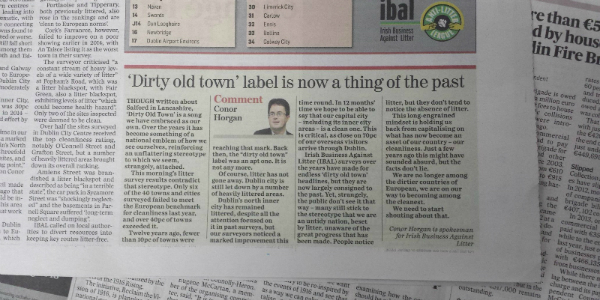
Though written about Salford in Lancashire, Dirty Old Town is a song we have embraced as our own. Over the years it has become something of a national emblem of how we see ourselves, reinforcing an unflattering stereotype to which we seem, strangely, attached.
This week’s litter survey results give lie to this stereotype. Only 6 of the 40 towns and cities surveyed failed to meet the European benchmark for cleanliness last year, and over 40% of towns exceeded it. 12 years ago, fewer than 10% of towns were reaching that mark. Back then, the “dirty old town” label was an apt one. It is not any more.
Of course, litter has not gone away. Dublin City is still let down by a number of heavily littered areas. The North Inner City has remained littered despite all the attention focussed on it in past surveys, but our surveyors noticed a marked improvement this time round. In 12 months time we hope to be able to say that our capital city – including the inner city areas – is a clean one. This is critical, as close on 70% of our overseas visitors arrive through Dublin.
IBAL’s surveys over the years have made for endless ‘dirty old town’ headlines, but they are now largely consigned to the past. Yet, strangely, the public don’t see it that way – many still stick to the stereotype that we are an untidy nation, beset by litter, unaware of the great progress that has been made. People notice litter, but they don’t tend to notice the absence of litter.
This long engrained mindset is holding us back from capitalising on what has now become an asset of our country – our cleanliness. Just a few years ago this might have sounded absurd, but the facts don’t lie. We are no longer among the dirtier countries of European, we are on our way to becoming among the cleanest. We need to start shouting about that.
We sell ourselves to tourists and to food consumers as a country of rare natural beauty and resources. Being a clean country really supports that message. Failte Ireland needs to include cleanliness among it selling points. On a more local level, the many towns that are consistently cleaner than European norms need to start marketing themselves as such to visitors and potential investors.
We’ve moved on from Dirty Old Town. It’s time to start humming a different tune.
This article, written by Conor Horgan in his capacity as spokesperson for Irish Business Against Litter (IBAL), appeared in the Irish Independent in January 2015.